Validate
Commands for checking model quality — locally, against a live model, and in CI. See Output & scripting for the CI-specific flags.
bpa — Best Practice Analyzer
bpa run evaluates the model against a rule collection and reports findings
by severity; --fix applies auto-fixes where the rule provides one
(FixExpression).
Besides property assignments (IsHidden = true) and Delete(), a fix expression can
rewrite the object's DAX:
| Fix expression | Rewrite | Used by |
|---|---|---|
QualifyColumnReferences() |
[Amount] → 'Sales'[Amount] |
DAX_COLUMNS_FULLY_QUALIFIED |
UnqualifyMeasureReferences() |
'Sales'[Total] → [Total] |
DAX_MEASURES_UNQUALIFIED |
Only the flagged references change; formatting and comments are kept. A reference the
rewrite cannot resolve for certain leaves the expression untouched and is reported under
fix errors instead. For example, a column name that exists in more than one table, a
name that also appears as a string literal (a column the expression builds with
ADDCOLUMNS), or a measure qualified with a table it does not belong to.
When fixes or rule-ignore changes are saved, the shared validation gate blocks
new model errors before writing. Use --force to save and report them anyway,
or tx config set validateOnSave false to disable the gate (default: on).
The default standard ruleset is a curated high-signal subset of the bundled
catalog — rules that catch broken models, expensive-at-scale patterns, and a
small core of consumer-experience checks. Use --ruleset full for the entire
bundled catalog (including style, advisory, and heuristic rules that fire on
most models).
standard also drives the deploy BPA gate, which blocks on
error-severity findings by default. Error severity is therefore reserved for
findings that mean the model is broken: a data column with no source column,
an expression-reliant object with no expression, invalid characters in a name
or description, USERELATIONSHIP against a table with row-level security, and
sort-by or hierarchy columns hidden from MDX. Everything else in standard is
a warning or info that bpa run reports without blocking a deploy
(deploy --bpa-fail-on warning blocks on warnings too).
A few rules — high-cardinality bi-directional relationships, large unpartitioned
tables, and referential-integrity violations — read VertiPaq statistics. On a
model without them (no Vertipaq_* annotations), these rules are not run: bpa run
lists them under "Not checked" and doesn't count them as passed. In JSON they
appear in missingVertipaqStatsRules and as MissingVertipaqStats diagnostics.
They don't fail the run. To check them, write the statistics into the model first
with tx vertipaq --annotate --save. Statistics only exist on a deployed model, so this
works on a connected model, or on a local model connected in workspace mode (the
statistics are read from its deployed mirror). A model file with no deployed copy
can't be checked by these rules.
The bundled catalog is embedded in the application and cannot be overridden by
placing a file beside the executable. Use --rules, model rule annotations, or
the bpa rules commands for explicit customization.
Models can carry their own rules: the BestPracticeAnalyzer annotation embeds
rule definitions directly, and the BestPracticeAnalyzer_ExternalRuleFiles
annotation lists rule files to load. Relative external-file paths resolve
against the model's folder (not the current directory), and Windows-style
separators (..\.devops\bpa-rules.json) work on every platform. When the same
rule ID appears in more than one source, the higher-precedence source wins:
ruleset < user rules (--rules, config-dir bpa-rules.json) < external files
< model-embedded — so a model's own rules always override the ruleset copy.
Among multiple external files, earlier entries in the annotation win. To detach
a model from an external rule file, remove the annotation:
| Option | Description |
|---|---|
-r, --rules <file> |
BPA rule files or URLs, as JSON. |
--ruleset <name> |
Standard ruleset: standard (curated default), full, microsoft, microsoft-it, microsoft-ja, microsoft-es. |
--rule <id> |
Run only specific rule(s) by ID. |
--path <path> |
Limit analysis to matched objects (literal names, wildcards, or paths). |
--errors / --warnings / --info |
Show only rules of that severity (combinable). |
--fail-on <threshold> |
Failure threshold: error (default) or warning. Rules that cannot be evaluated count as error-severity findings and block under either threshold. |
--fix |
Fix violations whose rules provide a fix expression. Destructive Delete() fixes are skipped unless --allow-delete is set. |
--allow-delete |
With --fix: also apply destructive Delete() fixes that remove model objects. Reference tracking cannot see report visuals or external consumers, so review staged changes before deploying. |
--dry-run |
With --fix: list each fix as Would fix: (or Would delete:) with the property's before and after values, and apply, save, and stage nothing. --save, --save-to, and --stage are ignored, and --allow-delete does not ask for confirmation. |
--save / --save-to <path> |
Persist the model after applying fixes. |
--details / --full |
Show full guidance per rule / list every affected object. |
--no-multiline |
Show each rule's guidance on one line. Text output only. |
--no-model-rules / --no-defaults |
Skip rules embedded in the model / leave the selected standard ruleset out. |
--allow-external-rules |
Also load remote (URL) rule files referenced by the model's rule annotations. Skipped by default so a model file cannot make tx fetch arbitrary URLs. |
--ci <github\|vsts> |
Print CI log-group commands to stderr. |
--trx <path> |
Write results to a .trx test-run file. |
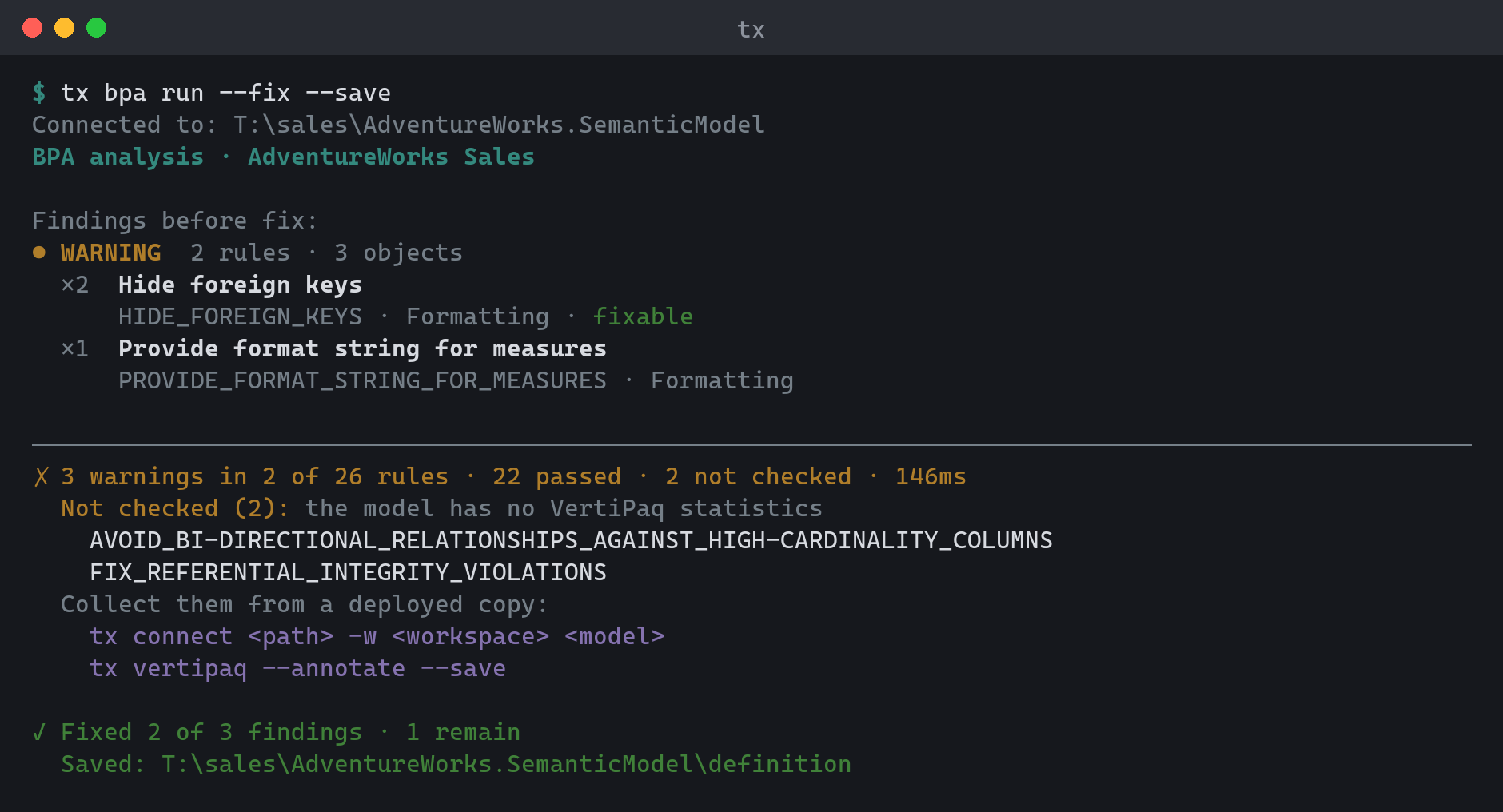
Text output groups findings by severity. Each rule shows its object count, its name,
and a line with its ID, its category and whether it is fixable. --details adds the
guidance and lists the affected objects one per line. The summary line counts the
findings and shows how many of the evaluated rules passed; rules that were not
checked for lack of VertiPaq statistics are counted separately. Next-step commands are
printed ready to copy on stderr, reusing your model path and rule options. After
--fix, the output shows how many findings were fixed and remain, and whether the
result was saved, staged, or kept in memory only. The rules are evaluated again after
fixing, and the exit code and --fail-on apply to the findings that remain, so a run
that fixes every blocking finding exits 0. JSON reports this as remaining.
--fix --dry-run previews the fixes without changing the model. Each pending fix is
listed with its rule and, for a property fix, the value before and after
(IsHidden: "false" → "true"); the summary says how many findings the fixes would
leave. Because nothing changed, the exit code and --fail-on apply to the model as it
is. JSON sets dryRun and status: "dryRun", keeps fixesApplied at 0, and adds
fixesPending, wouldRemain, and a fixes array (ruleId, objectType,
objectPath, action of set or delete, property, before, after), so CI can
diff a preview. Without --dry-run, fixes lists the fixes that were applied.
bpa run --fix --allow-delete deletes model objects, so it asks for
confirmation; --revert (drops staged work) asks too. Pass --yes to skip
the prompt in scripts.
bpa rules manages rule collections:
| Subcommand | Description |
|---|---|
bpa rules list |
List rules from every source, grouped by category, with each rule's severity, scope, status, and whether it is fixable. Includes the rules in your config-dir bpa-rules.json (source user). With a model, also lists the model's embedded and external-file rules (remote URLs are reported, not fetched) and any rule-load diagnostics. A rule on the model's ignore list shows as ignored; one turned off with bpa rules disable shows as disabled. |
bpa rules show <rule-id> [model] |
Show one rule in full: description, reference link, source, scope, expression, and fix expression. Accepts --ruleset and --no-defaults like list. An unknown ID fails with TOMIX_BPA_RULE_NOT_FOUND and suggests IDs that contain what you typed. |
bpa rules enable / bpa rules disable |
Turn a built-in rule back on, or off, for this user. |
bpa rules ignore / bpa rules unignore |
Add or remove a rule on the model's ignore list. |
bpa rules add [model] --id <id> ... |
Add a custom rule to your rules file, or to the model's rules with a model. Needs --name, --scope, and --expression; see Authoring rules. |
bpa rules set <rule-id> [model] ... |
Change fields of a rule in your rules file or the model's rules. |
bpa rules remove <rule-id> [model] |
Delete a rule from your rules file or the model's rules. |
bpa rules init |
Create an empty rules file. |
disable and ignore check the rule ID first, so a typo can't silently turn off
nothing. The ID must belong to the bundled catalog (every ruleset), your config-dir
bpa-rules.json, the selected --rules-file, or, for ignore, the model's embedded
or local external rules. An unknown ID fails with TOMIX_BPA_RULE_NOT_FOUND and suggests
close matches. If a rule source can't be read (for example, a remote rule file,
which is never fetched here), the check is skipped. Pass --allow-unknown to use an
ID anyway. enable and unignore accept any ID, so you can always clean up an entry
for a rule that no longer exists.
bpa rules --rules-file <file> points the subcommands at a BPA rules JSON
file. bpa rules list narrows what is listed:
| Option | Description |
|---|---|
--ruleset <name> |
Standard BPA ruleset to list: standard, full, microsoft, microsoft-it, microsoft-ja, microsoft-es. |
--no-defaults |
Leave the built-in ruleset out of the listing. |
--ignored / --disabled |
List only rules on the model's ignore list / only rules disabled for this user. Pass both for either. |
--all |
Include disabled and ignored rules in the listing. |
Authoring rules
bpa rules add, set, remove, and init edit a rules JSON file: your config-dir
bpa-rules.json (~/.tomix, or $TOMIX_CONFIG_DIR), which bpa run loads on every
run, or the file named by bpa rules --rules-file <file>. Remote rule files can't be
edited (TOMIX_BPA_RULES_FILE_REMOTE). Fields tx does not know about are kept as they are.
| Option | Description |
|---|---|
--id <id> |
Rule ID (add only; set and remove take it as an argument). An ID the file already has fails with TOMIX_BPA_RULE_EXISTS. |
--name <text> |
Rule name shown in results. Required for add. |
--scope <types> |
Object types the rule checks, comma-separated, for example "Measure, CalculatedColumn". Required for add. Unknown types fail with TOMIX_BPA_RULE_INVALID_SCOPE, which lists the valid ones. |
--expression <expr> |
Rule expression; an object that matches it is a violation. Required for add. |
--severity <level> |
error, warning, or info (or 3, 2, 1). Defaults to warning. |
--category <name> |
Category the rule is grouped under. Defaults to Custom. |
--description <text> |
Guidance shown with violations. |
--fix-expression <expr> |
Fix that bpa run --fix applies. |
With set, pass only the fields to change; an empty value (--description "")
removes an optional field. add creates the file when it doesn't exist; set and
remove fail with TOMIX_BPA_RULES_FILE_NOT_FOUND. init won't replace an
existing file unless you pass --force. Built-in rules can't be edited or removed.
Turn one off with bpa rules disable, or override it by adding a rule with the same ID.
tx bpa rules add --id MEASURE_DESCRIPTIONS --name "Measures need a description" --scope Measure --expression "string.IsNullOrWhitespace(Description)"
tx bpa rules set MEASURE_DESCRIPTIONS --severity error
tx bpa rules remove MEASURE_DESCRIPTIONS
tx bpa rules --rules-file team-rules.json init
Rules that ship with the model
Give add, set, or remove a model (as the argument, or with --model, --recent,
or --server) and they edit the model's BestPracticeAnalyzer annotation instead of a
file. Those rules travel with the model, and bpa run and bpa rules list pick them up
as source model-embedded. The same field checks apply, and fields tx does not know
about are kept. A model and --rules-file together fail with
TOMIX_BPA_RULES_TARGET_CONFLICT.
The edit is a model mutation, like bpa rules ignore: nothing is written until you pass
--save (or --stage), and --save-to, --serialization, --revert, --no-sync, and
--force work as they do for set. Removing the last rule removes the annotation.
Rules found only under the old misspelled BestPractizeAnalyzer key are moved to the
correct key on the first edit. init only creates files.
tx bpa rules add . --id MEASURE_DESCRIPTIONS --name "Measures need a description" --scope Measure --expression "string.IsNullOrWhitespace(Description)" --save
tx bpa rules set MEASURE_DESCRIPTIONS . --severity error --save
tx bpa rules remove MEASURE_DESCRIPTIONS . --save
The BPA gate also runs automatically on deploy (--skip-bpa to bypass,
--fix-bpa to auto-fix first, --bpa-rules to point at specific rule files,
--bpa-fail-on to lower the blocking threshold to warnings — errors block by default).
The deploy gate honors bpa rules disable for the rules it loads. bpa run can
load additional user and model rules, so the commands may report different findings.
A rule that cannot be compiled or evaluated is itself an error-severity finding
("rule could not be evaluated: \<reason>"), so a typo in a rule expression fails
bpa run and the gates instead of silently skipping the rule.
On save, BPA runs only when --fix-bpa is passed; rules that cannot be
evaluated block the save even when other fixes were applied.
The gate never applies
destructive Delete() fixes — those are only available via
bpa run --fix --allow-delete.
validate — DAX and relationship integrity
Offline analysis runs on every DAX-bearing expression (measures, calculated
columns/items/tables, role filters, secondary measure expressions). Syntax is
checked first: illegal characters, unterminated string/table/bracket literals
and block comments, and unbalanced parentheses or braces are reported as
DAX0004/DAX0005 errors. When those pass, the DAX parser reports its first
grammar error: a missing comma or leftover text (DAX0007), a missing operand
(DAX0008), or a VAR without = or RETURN (DAX0009). When an expression's syntax is broken, its
reference checks are skipped, since a never-closed bracket makes everything
after it read wrong. Syntactically valid expressions then get the offline
reference checks (DAX0001–DAX0003, see error codes).
In text output each finding shows the offending expression line under its
message, syntax-highlighted when it came from DAX; --no-multiline collapses
the cell back to one line. Every issue carries a severity: --output-format
json includes it as a string ("severity": "Error" / "Warning") on each
issue, CI annotations emit errors as errors and warnings as warnings (the run
still exits 1 only for errors), and the TRX projection maps each issue's
severity to its test outcome.
| Option | Description |
|---|---|
--ci <github\|vsts> |
Print CI log-group commands to stderr so findings annotate the PR. The text table is then printed without wrapping (also under Azure Pipelines without --ci). |
--trx <path> |
Write results to a .trx test-run file. |
--errors-only |
Only show errors. |
--no-warnings |
Leave out analyzer warnings. |
--server-only |
Only show errors reported by the connected server. |
--no-multiline |
Show multi-line cell content on one line. Text output only. |
The banner names the model being validated: the TOM database name, falling
back to the Fabric .platform displayName, then to the file/folder name —
so a nameless TMDL folder still shows its own name instead of (unnamed).
test — DAX regression tests
Runs DAX regression tests against a live model and exits 1 on any mismatch,
so a pipeline can block a merge when a query result drifts. Each test is a
.dax file paired with a sibling <name>.expected.json snapshot; path is a
single test file or a directory searched recursively for .dax files
(default: the current directory). Test names are the file paths relative to
path, without the extension (totals/sales-by-region).
| Option | Description |
|---|---|
--update |
Record mode: run each query and (re)write its .expected.json from the actual result. Byte-identical snapshots are left untouched. |
--filter <pattern> |
Run only tests whose name matches a * wildcard pattern (case-insensitive). |
--param <name=value> |
Query parameter applied to every test, referenced as @name in DAX. Repeatable. |
--max-rows <n> |
Per-query row cap; a query exceeding it fails as an error (default: 10000). |
--ci <github\|vsts> |
Print CI log-group commands to stderr so failures annotate the PR. |
--trx <path> |
Write results to a .trx test-run file. |
Like query, tests execute on a deployed model (XMLA) or a local
instance — never on TMDL/BIM files. Target the model with -s <workspace>
-d <model> or the active session.
Workflow. Add a test by writing a .dax file (any EVALUATE query),
then record its snapshot:
tx test ./tests --update -s MyWorkspace -d MyModel   # record snapshots
tx test ./tests -s MyWorkspace -d MyModel            # verify: all PASS, exit 0
A test without a snapshot fails the run as MISS (a new test must not
silently pass); a result that drifts from its snapshot fails as FAIL with a
difference table. Accept an intentional change by re-running --update and
committing the snapshot diff — the git diff is the review artifact.
The snapshot stores column names/types and all cell values as canonical
invariant strings (null = DAX BLANK()), plus a hash of the query text
used to hint when a failing test's query changed since recording:
{
  "version": 1,
  "querySha256": "9f2c…",
  "columns": [
    { "name": "Sales[Region]", "type": "string" },
    { "name": "[Total Sales]", "type": "decimal" }
  ],
  "rows": [
    ["East", "1234.50"],
    ["West", null]
  ]
}
Rows compare in order — always end test queries with ORDER BY so
results are deterministic. Keep rowsets small and stable (aggregates,
TOPN over ordered sets); one EVALUATE rowset per file.
tx test ./tests
tx test ./tests/totals/sales.dax --update
tx test ./tests --filter "totals/*" --trx results.trx --ci vsts
vertipaq — storage statistics
VertiPaq Analyzer-style storage statistics for a live model, with .vpax
export/import for offline analysis.
| Option | Description |
|---|---|
--tables / --columns / --relationships / --partitions / --all |
Which view(s) to show (--columns is the default). |
--detail |
Extra columns: data/dictionary/hierarchy size breakdown, encoding, segments. |
--stats |
Model-level storage summary. |
--top <n> |
Limit each view to the N largest rows. |
--fields <list> |
Comma-separated fields to display (single view; text/csv only). |
--export <file.vpax> |
Export statistics to a .vpax file. |
--import <file.vpax> |
Analyze a previously exported .vpax offline (no connection needed). |
--obfuscate |
Mask names and expressions in the export; a private .dict dictionary keeps the mapping. |
--annotate |
Write statistics into the model as Vertipaq_* annotations (preview unless --save). |
--force |
With --annotate --save, write despite newly introduced validation errors and report them. |
tx vertipaq
tx vertipaq Sales --detail
tx vertipaq --stats --all --top 10
tx vertipaq --export stats.vpax
tx vertipaq --import stats.vpax --relationships
diff — compare two models
Compares two models (TMDL folders or .bim files) and shows structural
differences. Exit codes are CI-friendly: 0 = identical, 1 = differences
found, 2 = error.
When one side is a live database, engine-computed state is ignored so that comparing source files against a processed model reports only authored changes. An inferred measure data type present on only one side, calculated-table columns present on only one side, and data type differences between calculated-table columns present on both sides are not reported. Other column property changes remain visible. Comparing two authored sources reports these differences because they may be authored changes.
In JSON output, each row of data.changes has the following fields. The
objectType and path meanings depend on the action:
| Action | objectType |
path |
oldValue / newValue |
|---|---|---|---|
added |
Object kind, for example Measure. |
Object path, for example Sales/Total Sales. |
Omitted. |
removed |
Object kind. | Object path. | Omitted. |
modified |
Object kind followed by / and the object path, for example Measure/Sales/Total Sales. |
Property name, for example Description. |
Previous and new property values; each field is omitted individually when its value is null. |
Scripts should use this current shape until a future major release introduces
objectPath and property with a deprecation window for the existing fields.
The replacement schema and release timing will be decided in that later work.
doctor — environment check
Checks whether the local tomix environment is ready. When filing a bug, attach its output.
The report is safe to share by default: your home directory is shown as ~,
and account, server, database, model, profile, and session names are replaced
by what kind of thing they are (for example directory session: Power BI /
Fabric workspace). Add --show-details to include them, for your own
troubleshooting.
doctor is strictly local and deterministic: it checks config-directory
read/write access, configuration validity, profiles, sessions (and reports
stale ones, which the next tx connect <target> removes), the current
session's connection, cached sign-in metadata (and, on Windows, that the
matching token cache file exists), and the cached update record. It never
opens the OS keystore, refreshes credentials, or contacts a model/release
service. It does not create the config directory: on a machine where tx has
not run yet, it reports that the directory will be created on first use. In an
existing config directory it writes and deletes one temporary file to test
write access. The version, how tx was installed, OS, .NET runtime, and terminal
capabilities are reported in the header in both text and JSON output. A newer
release is a WARN only when tx update can install it; a source build
(./tx) reports it as INFO.
Each check reports one status:
| Status | JSON status |
Meaning |
|---|---|---|
OK |
Pass |
Healthy. |
INFO |
Info |
A normal optional state, such as no profiles, not signed in, or no update check yet. |
WARN |
Warning |
Works, but needs attention, such as an available update or a missing token cache. |
FAIL |
Fail |
Broken; doctor exits 1. |
OK, INFO, and WARN exit 0; any failed health check exits 1.
It remains runnable when config.json is corrupt so the report can identify
the failure and direct recovery with tx config init --force.